Technical
IP Ratings for Outdoor Lighting in the UAE
The IP number is only half the specification. In UAE conditions, heat, salt air and irrigation water kill more outdoor fittings than rain ever will.
7 min readZiera INC
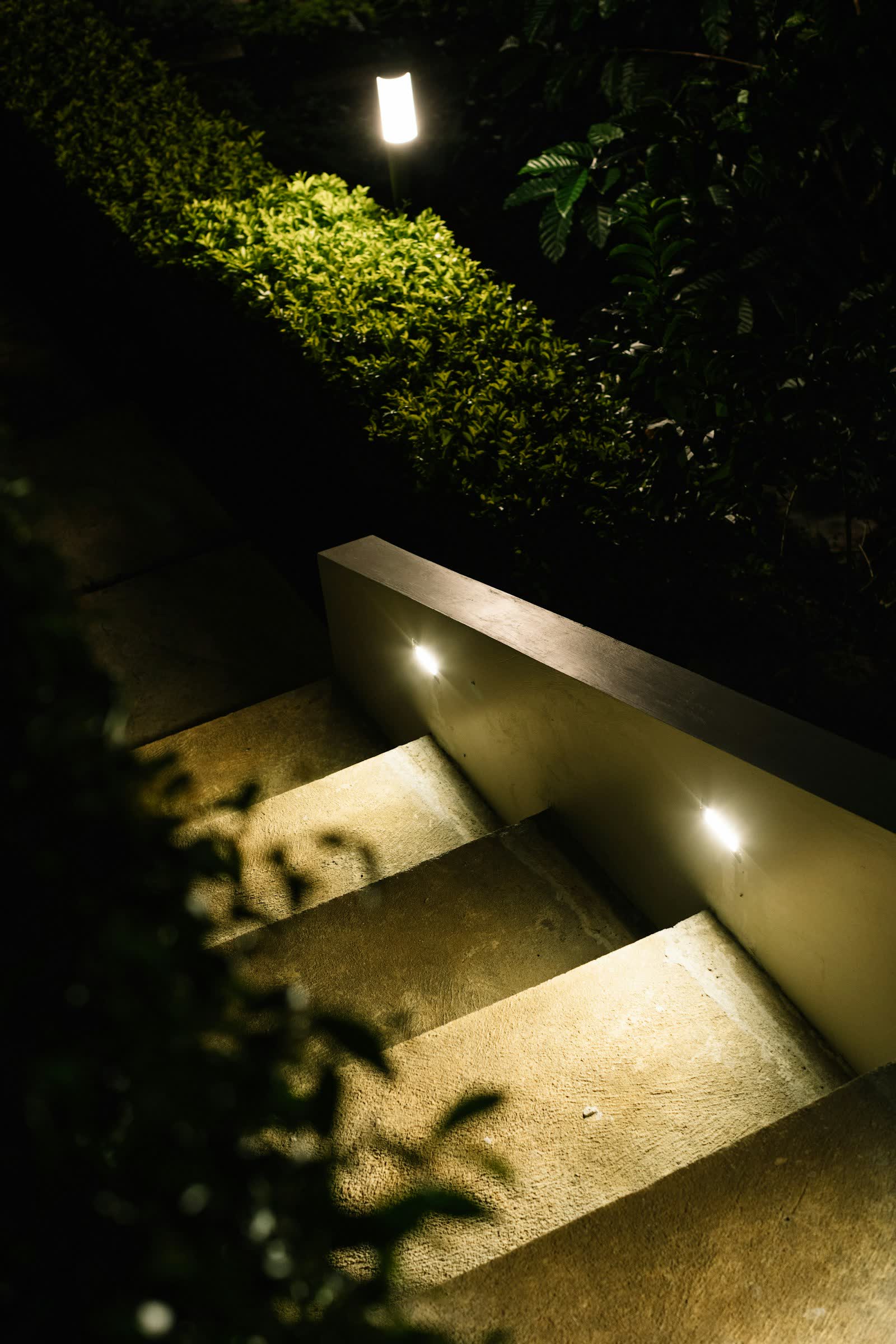
Every outdoor luminaire carries an IP rating, and almost every specification treats it as a single hurdle to clear: is it IP65? Yes? Fine. That reading is why so much outdoor lighting in the UAE fails within two or three seasons — and it fails for reasons the IP number does not describe at all.
Reading the number
IP stands for Ingress Protection. The first digit is solids, the second is liquids. Higher is more protected, and the two digits are independent.
| Rating | Protected against | Real-world meaning |
|---|---|---|
| IPx4 | Splashing from any direction | Covered balconies only. Not genuine outdoor use. |
| IPx5 | Low-pressure jets from any direction | Rain and hose spray. The practical minimum outdoors. |
| IPx6 | High-pressure jets | Wash-down areas, coastal exposure, pressure cleaning. |
| IPx7 | Immersion to 1m for 30 minutes | In-ground fittings, planters, anywhere water stands. |
| IPx8 | Continuous immersion beyond 1m | Pool and water-feature fittings. Permanently submerged. |
The first digit matters more here than in most climates. IP6x means completely dust-tight, and in a region with regular fine airborne dust and periodic shamal winds, that first digit is doing real work. An IP54 fitting is not merely less waterproof than IP65 — it lets dust into the optic, which fogs it and cooks the LED.
What each position actually needs
| Position | Minimum | Why |
|---|---|---|
| Covered soffit, sheltered balcony | IP54–IP65 | Little direct water, but dust still gets in |
| Exposed wall and facade lights | IP65 | Rain, wind-driven dust, occasional hose |
| Bollards and path lights | IP65 | Rain plus irrigation spray at low level |
| Spike spots in planting | IP65–IP67 | Irrigation soaks the base repeatedly |
| In-ground uplighters | IP67 | Sit in standing water after every irrigation cycle |
| Step and deck lights | IP67 | Water pools on and around them |
| Pool surround (dry side) | IP66–IP67 | Splash-out plus chlorinated water and wash-down |
| In-pool and water features | IP68 | Permanently submerged |
What the IP rating does not tell you
Three UAE-specific failure modes are invisible in the IP number, and between them they account for most of the outdoor fittings that die early here.
Heat
A luminaire specified for a European garden assumes an ambient temperature of perhaps 25°C. A black fitting on a south-facing wall in Dubai in July sees surface temperatures well above 50°C before it is even switched on. LEDs and drivers both lose life rapidly with temperature. Check the rated maximum ambient (Ta) on the datasheet — if it says 25°C, that product is not specified for this region, whatever its IP rating.
Salt and corrosion
Within a few kilometres of the coast — which is most of the UAE's residential development — salt-laden air attacks metals continuously. 316 marine-grade stainless, properly anodised aluminium or a genuine architectural powder-coat will hold. Chrome-plated and cheap-coated fittings pit within a season, and the resulting rust streaks run down whatever stone or render sits below them. That staining is a far bigger problem than the failed fitting, because it does not come off.
Gasket ageing
IP ratings are tested on a new product. Silicone and rubber gaskets harden with UV and heat, and a fitting that was genuinely IP67 on day one may be effectively IP54 after three UAE summers. This is why gasket quality and serviceability — can the seal be replaced? — matter more here than the headline number.
Installation details that void the rating
A correctly rated fitting installed badly is an unrated fitting. The commonest errors:
- Cable glands not tightened onto the correct cable diameter. The gland is the seal; the wrong cable size leaves a gap.
- Cut LED strip or neon flex ends left unsealed. A cut end is an open end regardless of the profile's rating.
- Drivers rated IP20 installed in an outdoor enclosure that is not itself sealed.
- In-ground fittings installed without the drainage layer beneath them, so they sit in a permanent sump.
- Junction boxes buried in soil rather than mounted in an accessible, drained position.
Specifying properly
- State the IP rating per position, not once for the whole scheme. A facade light and an in-ground uplighter have different requirements and should not share a line item.
- Check Ta (maximum ambient) on every datasheet and reject anything rated below 40°C for exterior use here.
- Specify housing material explicitly — 316 stainless or anodised aluminium near the coast.
- Keep drivers out of the weather where possible: run low-voltage output to the fittings and house the drivers in a ventilated, shaded, accessible enclosure.
- Plan for replacement. Outdoor fittings are consumables on a ten-year view; if a fitting cannot be reached without lifting paving, that is a design fault.
From the catalogue
Outdoor and landscape lighting
IP65 to IP68 bollards, spikes, step lights, in-ground uplighters and facade washers specified for UAE heat and coastal air.
Browse outdoor lightingQuestions
Frequently asked
- What IP rating do I need for outdoor lights in the UAE?
- IP65 is the minimum for anything exposed to rain and hose spray, such as wall and facade lights and bollards. Use IP67 for in-ground uplighters, step lights and anything in planting that irrigation soaks, and IP68 for pool and water-feature fittings that are permanently submerged.
- What is the difference between IP65 and IP67?
- Both are fully dust-tight. IP65 resists low-pressure water jets from any direction — rain and hose spray. IP67 additionally survives immersion in up to a metre of water for 30 minutes, which is what an in-ground fitting sitting in standing irrigation water actually experiences.
- Is IP65 enough for lights near a swimming pool?
- Not for anything close to the water. Use IP67 as a minimum on the dry surround, where splash-out, chlorinated water and wash-down all occur, and IP68 for any fitting inside the pool itself. IP65 is only adequate well back from the pool edge.
- Does a high IP rating mean the light will survive UAE summer?
- No — the IP rating says nothing about heat. Check the maximum rated ambient temperature (Ta) on the datasheet: a fitting rated for 25°C ambient is not specified for this region regardless of its IP number. Housing material matters too, since salt air corrodes cheaply plated fittings within a season.
- Can an IP-rated fitting still fail from water ingress?
- Yes, in two common ways. Gaskets harden with UV and heat, so a genuinely IP67 fitting can be effectively IP54 after a few UAE summers. And installation defeats the rating easily — an untightened cable gland, an unsealed cut end on strip or neon flex, or a buried junction box will let water in whatever the fitting is rated.
Shop the categories