Guides
Magnetic Track Lighting: A Complete Specification Guide
Magnetic track has become the default ceiling system in UAE fit-outs, for one reason: it is the only system where the lighting layout is not final at first fix.
8 min readZiera INC
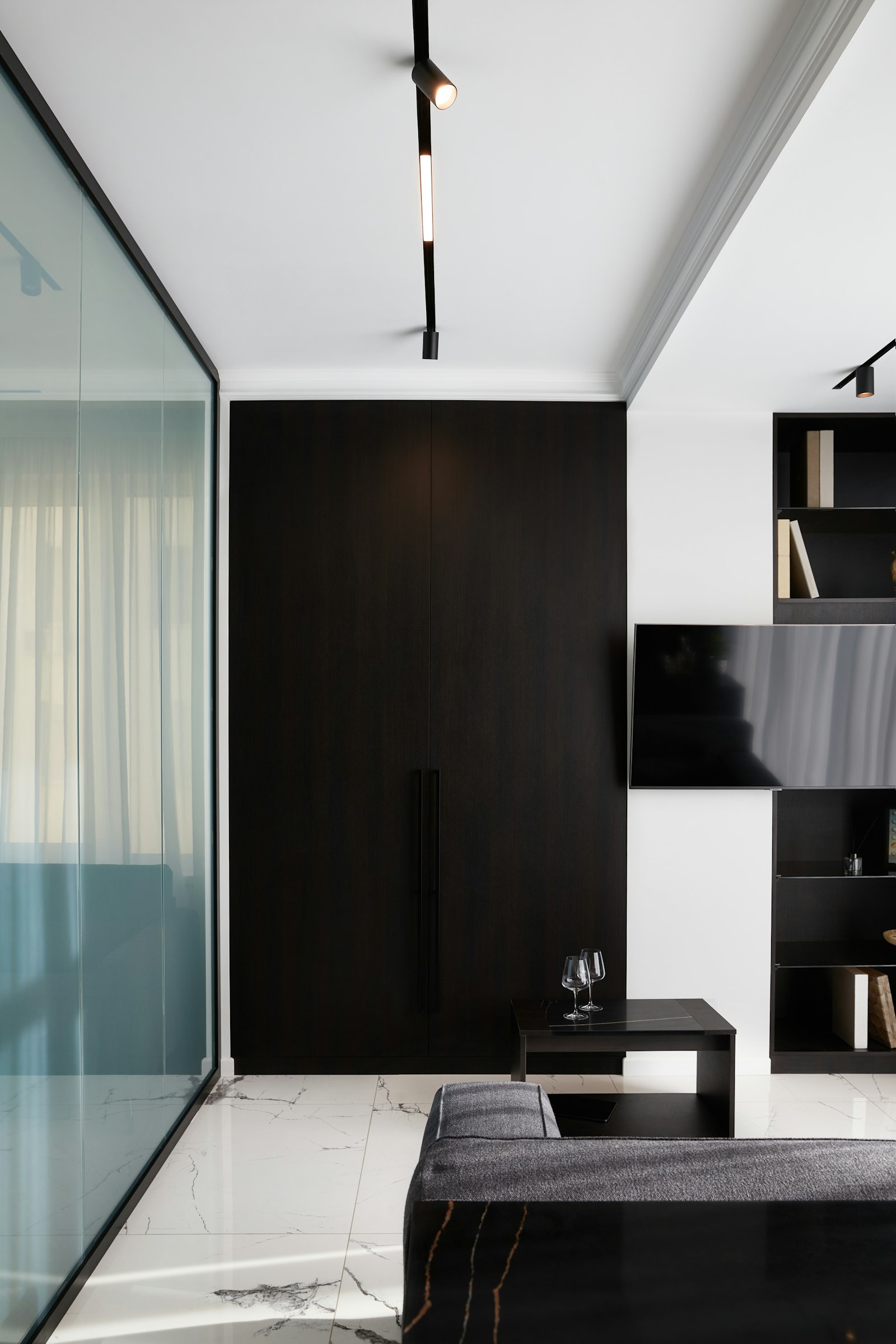
Every other ceiling system commits you at first fix. Downlight positions are cut into gypsum and that is where the light is, permanently. Magnetic track breaks that: the electrician installs a 48V track and a remote driver, and every luminaire after that clips on magnetically and moves whenever you want it to.
In a region where apartments are re-let, retail is re-merchandised every season and villa interiors get reworked, that flexibility is the entire argument — and it is why magnetic track has moved from a retail product to the default residential ceiling system in UAE fit-outs within a few years.
How the system works
Three components, and understanding the split is what prevents most specification errors.
- The track — an aluminium profile carrying two low-voltage conductors, installed recessed, on the surface, or suspended.
- The driver — a remote power supply converting 220–240V mains to 48V DC. It sits away from the track, in an accessible void.
- The modules — spots, floods, linear grazers, folding arms and pendants that clip magnetically anywhere along the track.
Because the track runs at 48V, the conductors are safe to touch and modules can be added, moved or removed without isolating anything. The mains connection and the driver still require a licensed electrician.
Choosing the format
| Format | Result | Decide by |
|---|---|---|
| Recessed | Flush or trimless line in the ceiling — the cleanest result | Must be set during gypsum work. Not retrofittable. |
| Surface | Visible profile mounted on the slab or ceiling | Any stage, including finished ceilings. Adds 25–35mm of depth. |
| Suspended | Track hung on cables below the ceiling | High ceilings, exposed-services interiors, over islands and counters. |
Sizing the driver
Under-sized drivers are the single most common fault on magnetic track installations, and they are insidious: the system works perfectly during commissioning with four modules on it, then flickers or drops out six months later when the client has added five more.
- Total the wattage of every module you intend to fit.
- Add at least 20% — more like 40% if the point of choosing magnetic track was future flexibility, which it usually was.
- Specify the driver at that figure, and confirm it is dimmable on the protocol the project is using.
- Give it an accessible, ventilated position. A driver sealed above closed gypsum will run hot and, when it fails, will require cutting the ceiling open.
A worked example: eight modules averaging 12W is 96W. Specify a 150W driver, not a 100W one. The cost difference is small and it is the difference between a system that accepts two more spots in year three and one that does not.
Choosing modules
The mistake here is uniformity. A track fitted end-to-end with identical 24° spots produces a row of matching pools on the floor and dark walls — visually, it is a downlight grid that happens to be movable. Mix the module types:
- Adjustable spots (15–24°) for artwork, objects and anything that should be a focal point.
- Floods (36–60°) for circulation and general fill.
- Linear modules for a continuous band of light — these do the ambient work and stop the ceiling reading as a row of points.
- Wall-wash modules where the track runs parallel to a feature wall.
- Folding-arm and pendant modules over tables and counters, so the decorative layer comes off the same track.
Consistency rules
Because every module on a track is seen simultaneously and at the same distance, mismatches are more visible here than anywhere else in a lighting scheme.
- One colour temperature across the whole run — 3000K for residential, 4000K where task visibility dominates. A single 4000K module in a 3000K run is immediately obvious.
- CRI 90+ throughout, particularly where finishes, timber or merchandise are being judged.
- One manufacturer and, where possible, one batch. Modules from different sources on one track show as a colour step along the ceiling even when both claim the same CCT.
- One finish. Black, white and bronze modules on the same track read as a repair, not a design.
Where it works, and where it does not
Magnetic track is excellent in living rooms, open-plan spaces, corridors, retail, galleries and anywhere with art or objects that will move. It is genuinely useful over kitchen islands and dining tables, where it lets the light follow furniture that has not been finalised.
It is a poor choice in bathrooms and wet areas, where the exposed conductors are inappropriate; in very low ceilings, where even a recessed track leaves modules protruding into head height; and in rooms with a single fixed function and no prospect of change, where ordinary downlights do the same job for less money. It is also the wrong answer if the budget is tight — magnetic systems cost meaningfully more per point than fixed downlights, and the premium buys flexibility rather than light.
Installation checklist
- Track layout agreed and drawn before gypsum work if recessed.
- Driver location fixed, accessible after handover, and ventilated.
- Driver rated with genuine headroom over the initial module load.
- Dimming protocol confirmed across driver, dimmer and any control system — matched as a set, not specified separately.
- Module schedule mixing beam angles rather than repeating one.
- Single CCT, single CRI, single finish, ideally a single batch.
- Spare modules ordered with the job, so later additions match the batch.
From the catalogue
48V magnetic track systems
Recessed, surface and suspended tracks with spots, floods, linear modules and pendants, plus matched dimmable drivers.
Browse magnetic trackQuestions
Frequently asked
- What is magnetic track lighting?
- A low-voltage ceiling system where an aluminium track carries 48V DC and light modules clip onto it magnetically. Because the track is low-voltage, modules can be added, moved or swapped by hand at any time without isolating the circuit — so the lighting layout is not fixed when the ceiling closes.
- What size driver do I need for magnetic track?
- Total the wattage of every module you intend to fit and specify a driver at least 20% above that — nearer 40% if the point of choosing magnetic track was future flexibility. Eight 12W modules total 96W, so specify a 150W driver rather than a 100W one. Under-sizing is the most common fault and typically shows up months after commissioning.
- Can magnetic track lighting be installed on a finished ceiling?
- Surface-mounted and suspended track can be installed at any point, including on finished ceilings. Recessed track cannot — it needs a plaster-in frame fixed before the gypsum is skimmed, so that decision has to be made before the ceiling closes.
- Is magnetic track lighting dimmable?
- Yes, but the dimming happens at the driver rather than the module, so the driver must be specified as dimmable and matched to the control protocol — TRIAC for simple wall dimmers, 0-10V or DALI for larger and smart-controlled installations. The driver, dimmer and control system all have to agree.
- Is magnetic track suitable for bathrooms?
- No. The track carries exposed low-voltage conductors, which is not appropriate in wet areas. Use sealed IP-rated downlights and dedicated mirror lighting in bathrooms, and keep magnetic track to dry living spaces, corridors and retail areas.
Shop the categories